By Lina Supnet-Zapata, MBA, CMC, TxCG
Aging Life Care Manager® and 2026 President-Elect, Aging Life Care Association®
You’ve noticed things that concern you.
The unopened mail stacking up on the kitchen counter. Forgotten conversations. Missed medications. A refrigerator filled with expired food. Maybe your parent seems more withdrawn than usual, or perhaps you are noticing changes during visits that weren’t there six months ago.
You gently bring it up.
“I’m worried about you.”
And the response comes quickly:
“I’m fine. I don’t need help.”
If this sounds familiar, you are not alone.
For many adult children, starting conversations about aging, care, and future planning can feel uncomfortable, emotional, and sometimes impossible. Yet these conversations are some of the most important ones families can have, especially before a health crisis forces urgent decisions.
The good news? This does not have to be one difficult conversation. It can be the beginning of an ongoing dialogue.
Why Families Delay the Conversation
One of the biggest misconceptions adult children have is believing there will be a “right time” to talk.
Often, parents avoid these conversations because they feel independent and capable. Some do not want their adult children involved in personal health or financial matters. Others simply struggle with what aging represents: change, vulnerability, and the reality of mortality.
Many families tell themselves:
- “Nothing major has happened yet.”
- “Dad still seems okay.”
- “Mom would tell me if something was wrong.”
But waiting until a crisis happens can create emotional strain, financial stress, and difficult family dynamics.
When there is no plan, families often find themselves making rushed decisions in emergency rooms, navigating confusion about legal authority, or scrambling to figure out finances and care options.
Planning ahead creates clarity and peace of mind.
The 40/70 Rule: Why Earlier Conversations Matter
I often encourage families to think about what I call the 40/70 Rule.
If the adult child is in their 40s and their parent is in their 70s, it is time to begin the conversation.
Not because something is wrong.
Because planning works best before something happens.
This stage of life provides an opportunity to begin talking informally about wishes, preferences, and future care. The goal is not to take control away from your parent. The goal is to understand how they want to age and how they would want support if circumstances changed.
Signs It May Be Time to Start the Conversation
You do not need to wait for a major medical event.
In fact, some of the most important warning signs appear quietly in everyday life.
Adult children often notice changes during holiday visits, vacations, or trips back home.
Common signs include:
Memory and Cognition
- Forgetting conversations that happened recently
- Missing appointments
- Increased confusion or forgetfulness
- Repeating stories multiple times
Financial Changes
- Unopened mail piling up
- Missed bills or late payments
- Unusual spending habits
- Increased anxiety or paranoia around finances
Physical and Personal Care
- Declining hygiene or refusal to bathe
- Noticeable weight loss
- Poor nutrition or relying on sweets instead of balanced meals
- Mobility changes or increased falls
Home and Social Changes
- Difficulty maintaining the home
- Increased isolation or withdrawal
- Reduced participation in activities they once enjoyed
- Safety concerns around driving
Sometimes these changes happen gradually, making them easy to dismiss. But taken together, they can indicate it is time to begin a conversation.
What a Good Early Conversation Should Cover
The best conversations are not formal interrogations.
They are conversational.
Instead of sitting down for one heavy, emotionally loaded discussion, try smaller conversations over time.
You might ask:
- “If there was an emergency, how would you want me to help?”
- “Have you thought about what you would want if staying at home became difficult?”
- “Who should the doctor call if something happens?”
- “Where do you keep important paperwork?”
Some of the most important topics families should understand early include:
Legal and Healthcare Planning
Families should know:
- Who is named as the medical power of attorney
- Who is named as the financial power of attorney
- Whether advance directives are completed
- Where important documents are stored
- Whether appointed agents have copies
During emergencies, many families discover too late that siblings don’t know who has decision-making authority or where documents were located. That confusion can create avoidable family conflict during already stressful times.

Medical Information
Adult children should understand:
- Healthcare providers involved in care
- Current medications
- Existing medical conditions
- Emergency contacts and preferred hospitals
Financial Logistics
It is also important to discuss practical questions:
If care is ever needed, how would your parent want finances handled?
Would someone need temporary access to funds to help pay for medications, caregiving, equipment, or healthcare expenses?
These conversations may feel uncomfortable at first, but discussing preferences ahead of time preserves dignity and reduces confusion later.
What to Do When Your Parent Says, “I’m Fine”
When a parent resists help, pushing harder usually backfires.
Resistance often comes from fear, loss of independence, or concern about losing control.
Instead of arguing, focus on staying connected.
Try these approaches:
Keep the Conversation Gentle
Avoid statements that feel critical.
Instead of:
“You can’t manage on your own anymore.”
Try:
“I want to make sure I understand what matters most to you.”
Curiosity is often more effective than correction.
Start Small
You do not have to solve everything immediately.
A conversation about emergency contacts today may eventually lead to discussions about healthcare wishes, finances, or caregiving support.
Think of this as an ongoing dialogue, not a one-time event.
Observe and Prepare
Even if your parent refuses help, preparation still matters.
If support is declined, adult children can still gather information, research resources, and begin building a plan.
Because eventually, a medical event, hospitalization, or urgent need often does happen.
Planning from a place of calm is always better than reacting in crisis mode.
When to Bring in an Aging Life Care Professional®
Sometimes families need a neutral third party.
This is especially true when:
- Family dynamics are complicated
- Adult children live far away
- A parent resists advice from family
- is not pleased with current care providers and requires advocacy
- is confused about their own financial and/or legal situation
- Care needs feel overwhelming
- Siblings disagree on next steps
An Aging Life Care Professional® can help families create what I often call a road map for care.
We help identify potential challenges before they become a crisis, coordinate moving parts, advocate for older adults, and guide families through difficult decisions.
You can think of an Aging Life Care Professional as the “air traffic control” for aging care, helping families navigate healthcare, housing, resources, safety concerns, and long-term planning.
For long-distance caregivers, this support can be especially valuable. Knowing someone local is helping oversee care and advocate for your parent can bring tremendous peace of mind.
How to Introduce the Idea Without Triggering Resistance
Parents may resist the idea of “help.”
So avoid framing it that way.
Instead, try:
“This isn’t about taking over. I just want us to have a plan in case something unexpected happens.”
Or:
“Let’s talk to someone who understands aging and planning, just so we know what options exist.”
Many Aging Life Care practices offer introductory consultations, allowing families to ask questions without pressure or commitment.
Sometimes simply hearing options from a trusted professional can make the conversation feel less intimidating.
Start Before You Need To
If there is one message I hope families take away, it is this:
Do not wait for a crisis.
Care conversations are not about giving up independence. They are about preserving choice.
The earlier families begin talking, the more opportunity parents have to express what matters to them and how they want to age.
Start small.
Stay curious.
Keep the conversation going.
Because the best care plans begin long before they are needed.
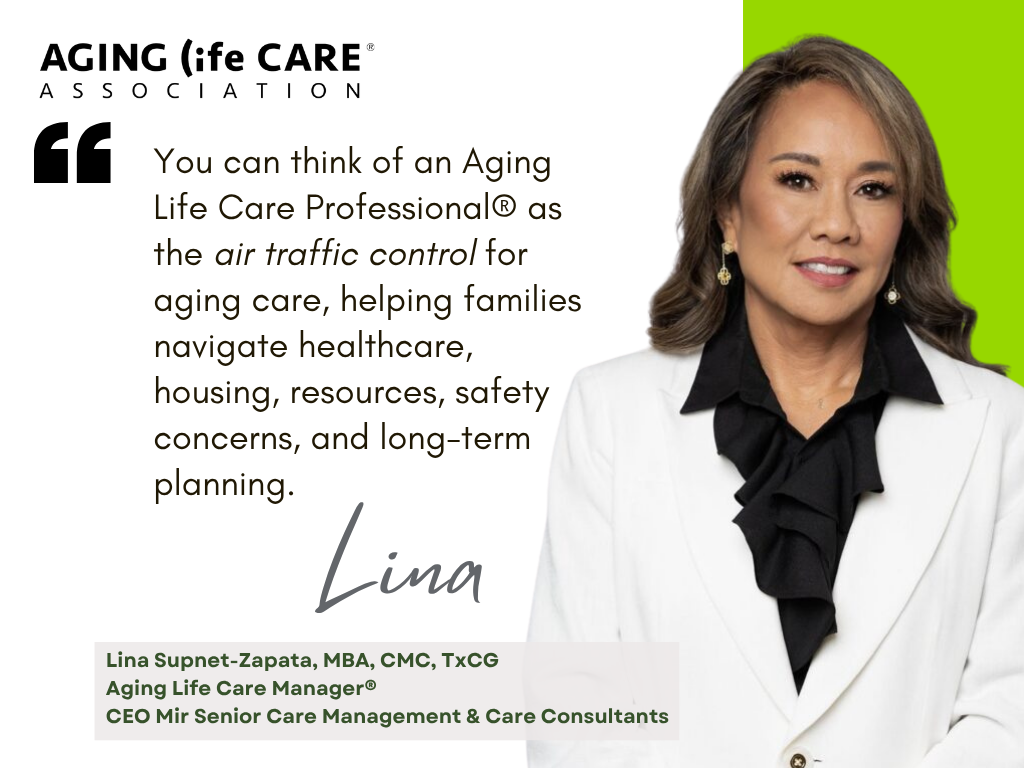
About the Author
Lina Supnet-Zapata, MBA, CMC, TxCG, is CEO of Mir Senior Care Management, Inc. & Care Consultants in Austin, Texas. An Advanced Professional member of the Aging Life Care Association® (ALCA) since 2016, Lina is a Care Manager Certified (CMC) professional through NACCM and a Certified Texas Private Professional Guardian. She currently serves on the ALCA Board of Directors and the Board of Directors for AGE of Central Texas. In 2022, she received the Joyce Lauck Legacy Award for her dedication to improving the lives of older adults and family caregivers.